The essentials
- A raised square of packed clay with a ring marked by straw bales, entered with a bow and treated as a sacred space rather than a stage.
- Before a bout the wrestler performs chiri-chozu, showing the gods and his opponent that his hands hold no weapons, and then throws salt.[1]
- A contest usually lasts only a few seconds, though in rare cases it can take a minute or more, so the ritual around it takes up most of the time.[2]
- Morning practice typically begins between 5:00 and 7:30 AM and continues for 2 to 4 hours, with the exact start varying by stable and season.[3]
- The Tokyo sumo entertainment show with chicken hot pot and geisha runs 2 hours, is wheelchair accessible and costs from US$102.[4]
- Top choice Sumo show & hot pot from US$102 Rating4.79 from 8,004 reviews[4]Duration2 hours[4]AccessWheelchair accessible[4]CancellationCancel up to 24 hours in advance[4] Check availability
- Morning practice tour from US$102 Rating4.78 from 720 reviews[5]Duration1.5 - 2 hours[5]AccessOptional audio guide: English[5]CancellationCancel up to 24 hours in advance[5] See this tour
- Sumo show & dining from US$89 Rating4.80 from 3,454 reviews[6]Duration1.5 - 2 hours[6]AccessWheelchair accessible[6]CancellationCancel up to 24 hours in advance[6] See this tour
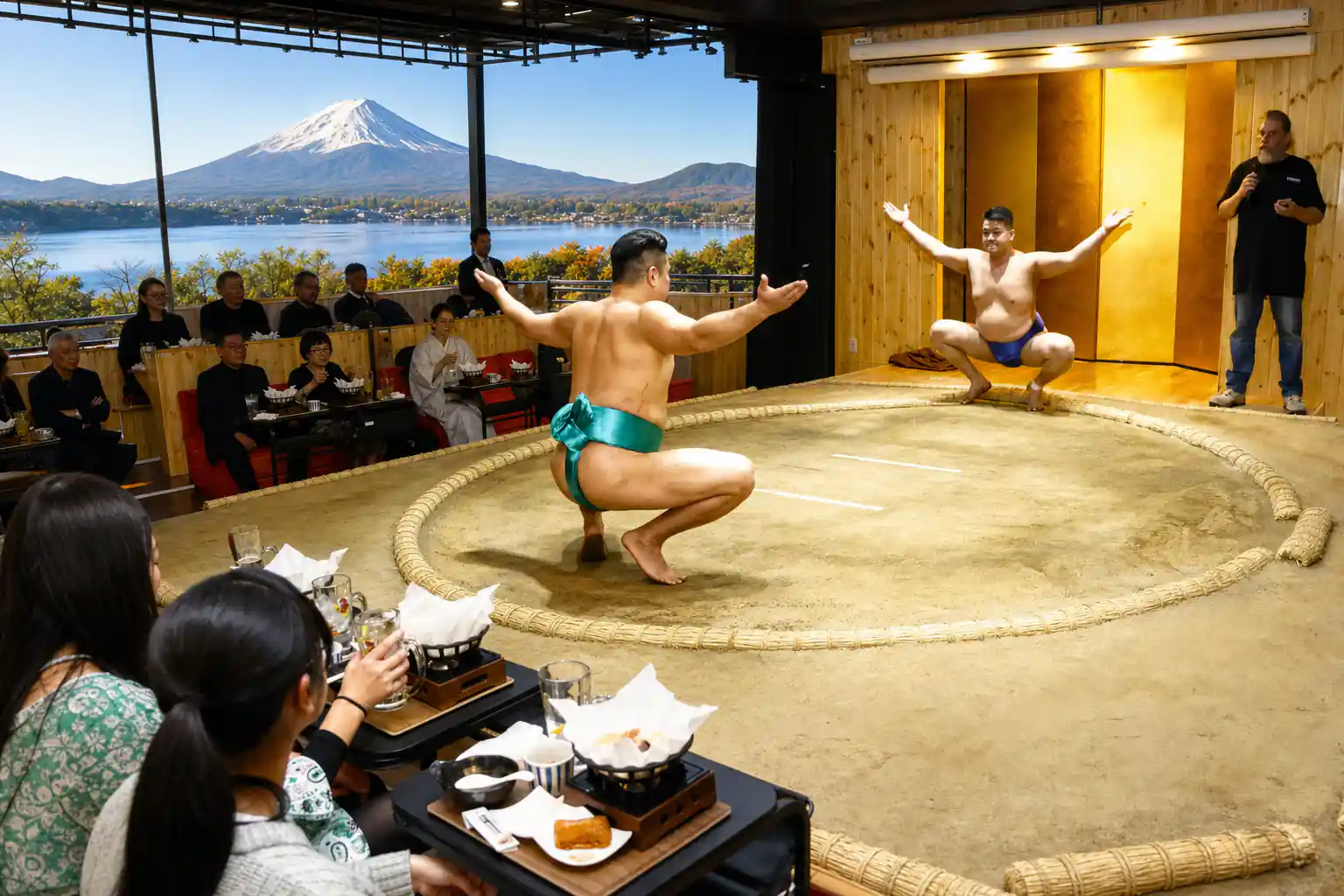
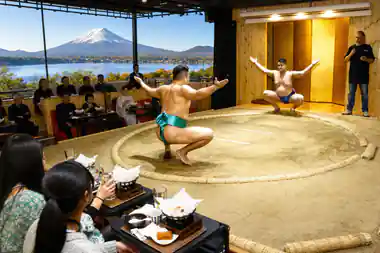
He then performs chiri-chozu : squatting low, extending both arms to the sides with palms turned upward, demonstrating to the gods and his opponent alike that his hands hold no weapons. He throws salt.
Verdict: see the ritual, then see the work
Timing and tickets
Harvest Rituals and the Shinto Roots of Sumo
Sumo looks like a sport and behaves like a ceremony. The referee in his robes, the wrestlers clapping their hands, the handfuls of salt arcing into the ring, the hush before the charge: all of it is ritual, and much of it is older than the buildings the sport is staged in today. The vocabulary comes from Shinto, and the ring is treated as a sacred space rather than a patch of clay.
Shrine festivals are where this kind of wrestling grew up. Bouts were offered to the gods and tied to the harvest and to prayers for good fortune, and the gestures that survive in the modern ring began as acts of offering and purification. Professional sumo took shape in the Edo period (1603-1867), when bouts raised money for constructing shrines and temples or replacing bridges, and the full-time wrestler emerged from that circuit.[11]
You can still see the seams. A tournament day opens with ceremony, the dohyo is swept and salted between bouts, and each wrestler enters the ring with a bow and a stamp. None of that is decoration: it is the part of sumo that marks the contest as an offering first and a match second.
Inside the Consecrated Dohyo Ring
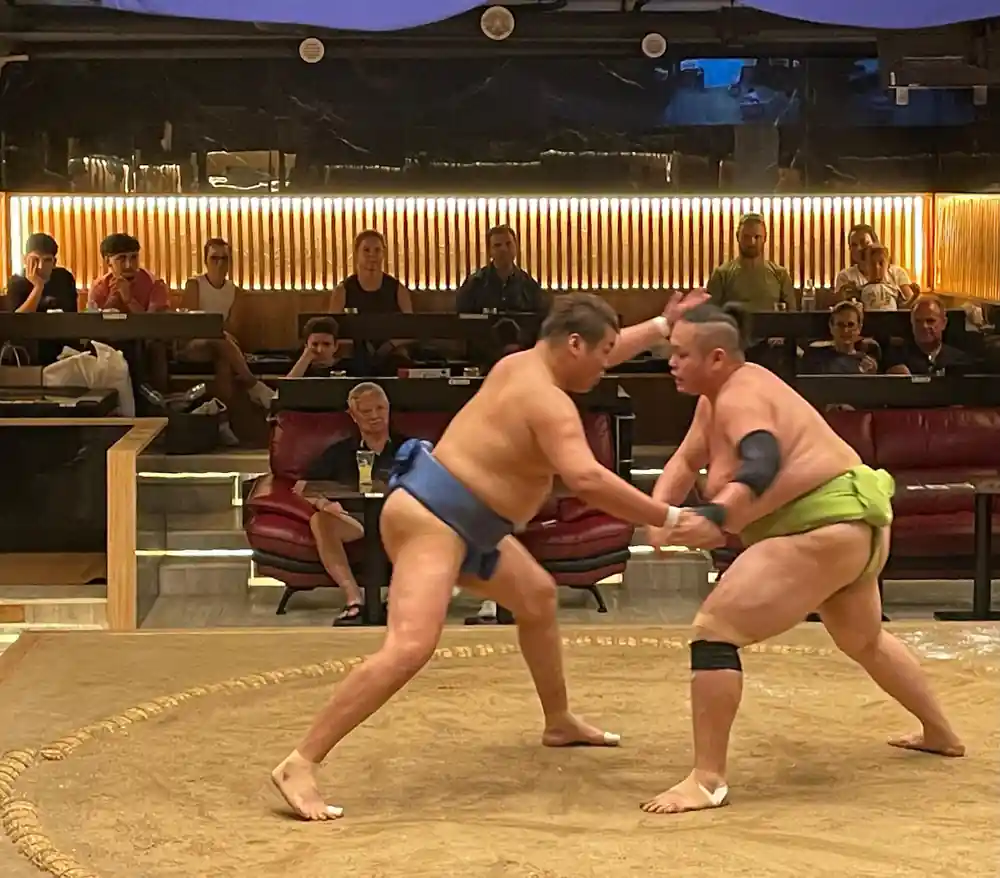
The dohyo is a raised square of packed clay with a ring marked out inside it by straw bales sunk into the surface. Wrestlers enter from either side, bow, and take up position inside the circle. The clay is swept between bouts and kept slightly damp, so a fall leaves a print, and the bales mark the boundary of the ring.
At the top of the professional game this happens at the Kokugikan National Sumo Arena in Ryogoku, Sumida City, Tokyo, which has a capacity of up to 10,000.[12] The hall sits in a neighbourhood of sumo stables, and on tournament days the streets around it fill with banners, food stalls and spectators drifting between the arena and the nearby shrines.
The ring is also a practical space, built to be swept, salted and stamped on all day. When a dohyo is set up inside a hall for a performance, the same elements appear: clay, bales, a bow, a stamp. It is designed to read clearly from every seat in the room.
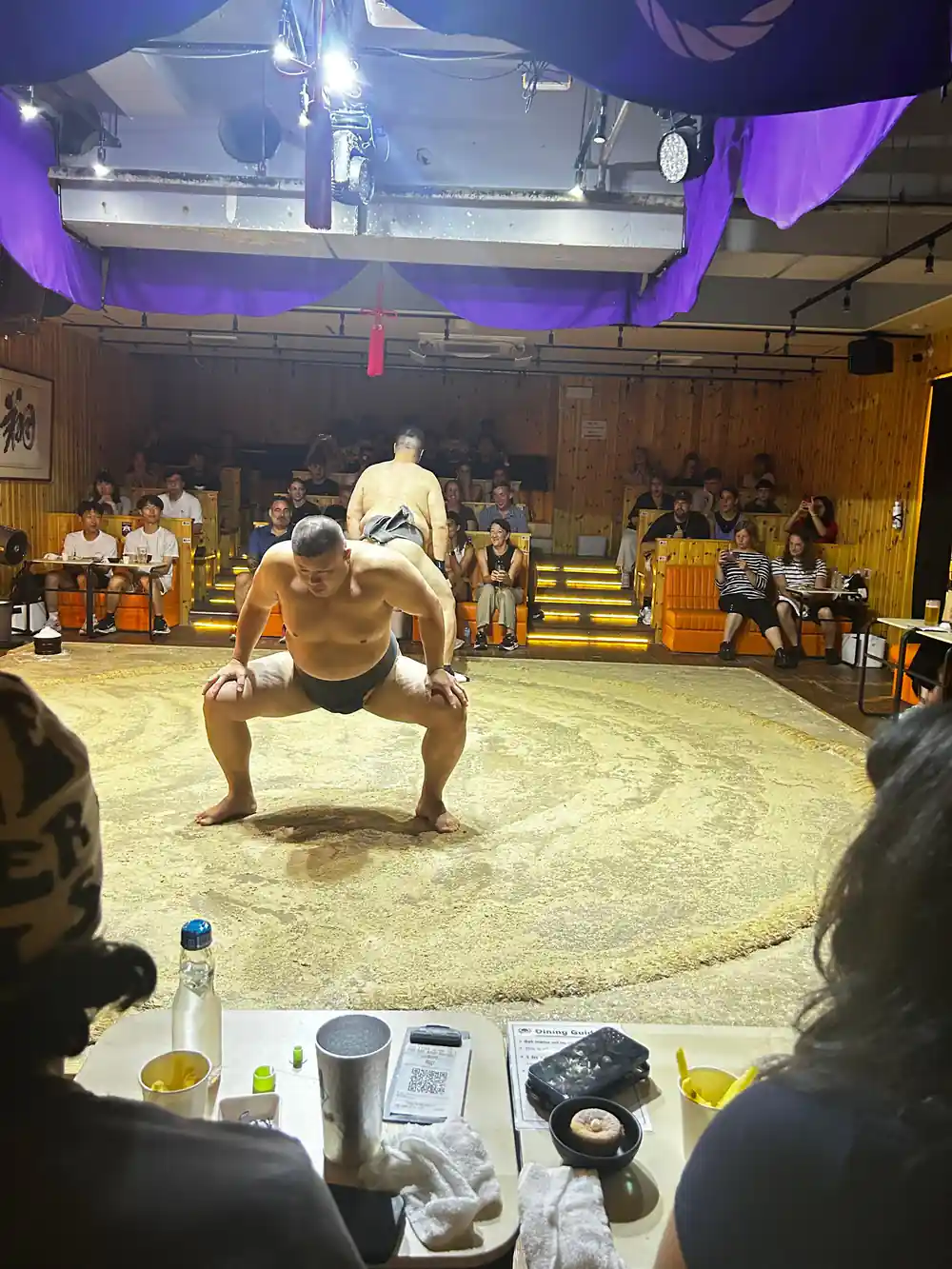
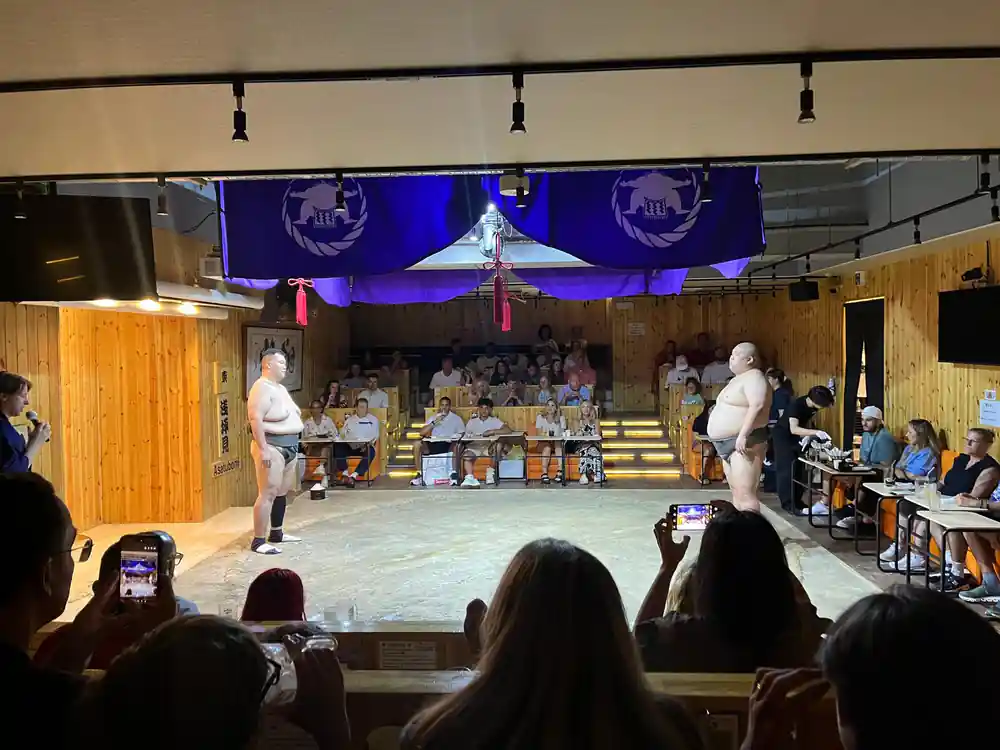
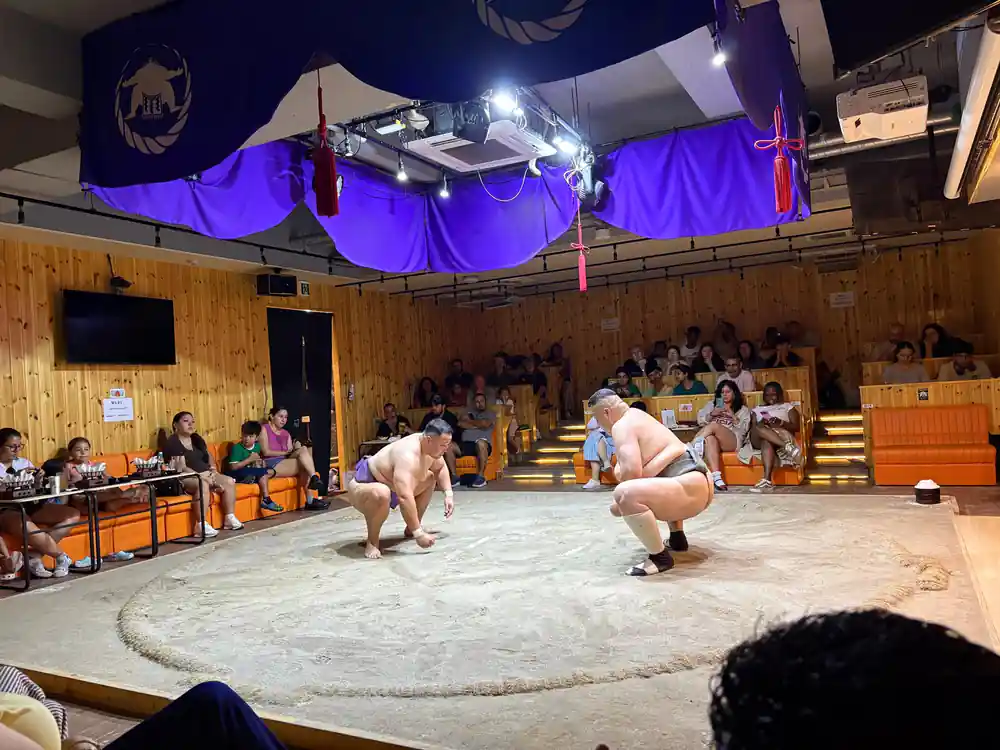
Wrestlers take the ring beneath the suspended roof at a Tokyo sumo show.
The Suspended Roof and Its Symbols
Above a proper dohyo hangs a roof, the tsuriyane, shaped like the roof of a shrine and suspended from the ceiling of the hall. It hangs low enough to frame the ring and give the space the feel of a chapel, and tassels hang from its corners. Underneath it, the clay circle becomes a lit stage with a boundary, and the audience looks down rather than across.
The tassels follow a traditional colour scheme, with green, red, white and black standing for directions and seasons in shrine practice. The roof is copied from shrine architecture, and in a modern arena it is a deliberate reminder that the space beneath it is not an ordinary sports floor.
Watch how the wrestlers treat it. They bow as they enter, they keep their movements inside the frame, and the referee works beneath it in robes borrowed from shrine dress. The roof does quiet work: it turns a contest into a ceremony from the moment the first wrestler steps under it.
Salt, Chiri-chozu and Purification Before a Bout
Salt is the most visible ritual in sumo. Wrestlers take a handful from a bowl at the edge of the ring and throw it across the clay before they crouch, and the gesture repeats through the day until the surface is dusted white at the edges. In Shinto practice salt is a purifier, and the ring is treated as a place that needs purifying before it is used.
The older gesture comes first. Before a bout the wrestler performs chiri-chozu, squatting low, extending both arms to the sides with palms turned upward, showing the gods and his opponent that his hands hold no weapons, and then he throws salt.[1] The bout has not begun, and the ring has already been addressed directly.
Wrestlers also rinse their mouths and stamp the clay before the final crouch, and the whole sequence is unhurried. Nothing is rushed until the moment two bodies meet in the middle of the circle.
from US$102
The Tokyo sumo entertainment show with chicken hot pot and geisha is the tour booked from this site, with a 2 hour run time.[4]
Shiko, Stomping and Ritual Movement
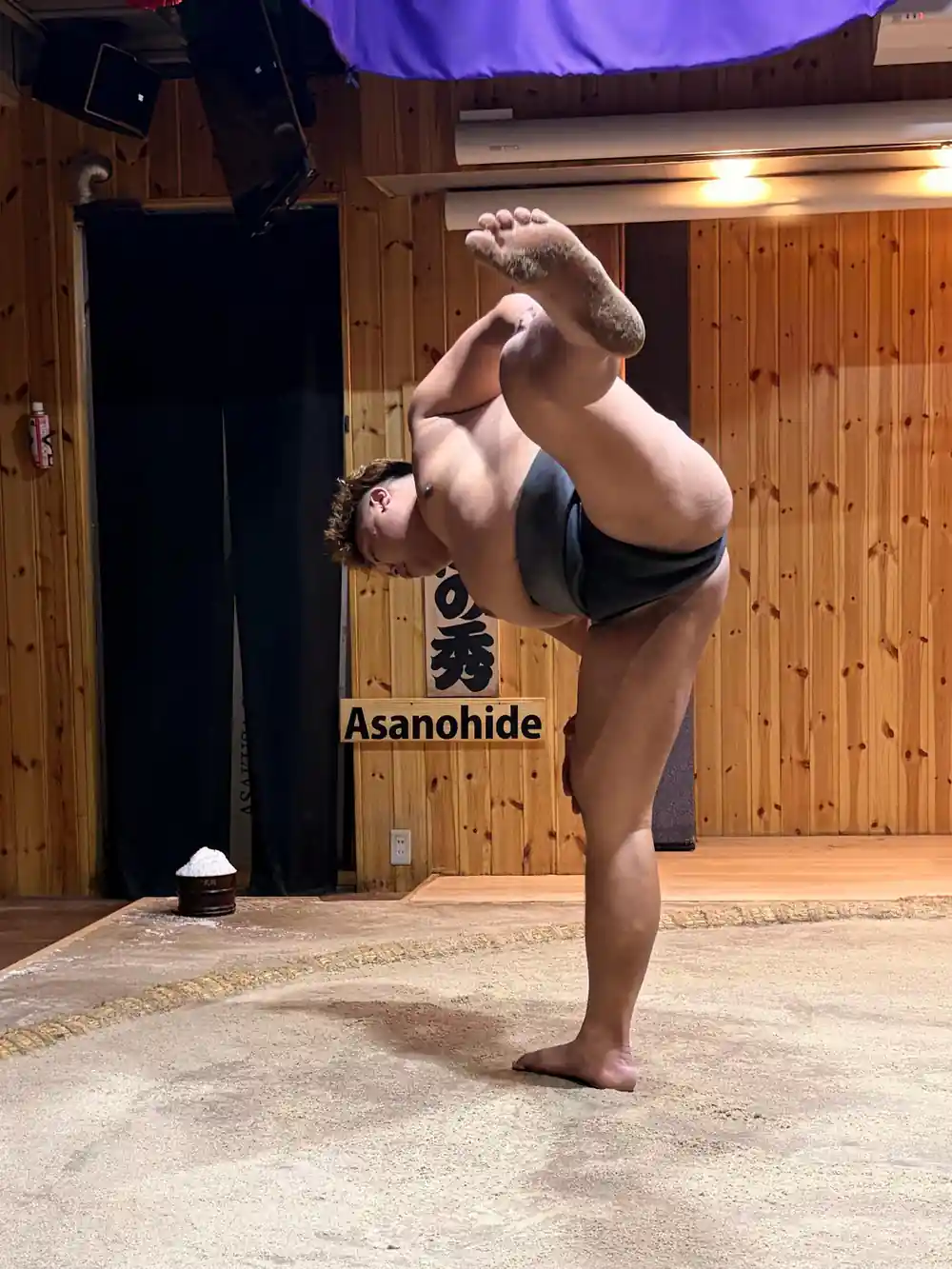
The shiko stomp is the move most people recognise without knowing its name. A wrestler lifts a leg high to the side, balances, and brings it down hard on the clay, then repeats on the other side, arms out and back straight. You see it at the start of a bout and in training, where it belongs to both the warm-up and the ceremony.
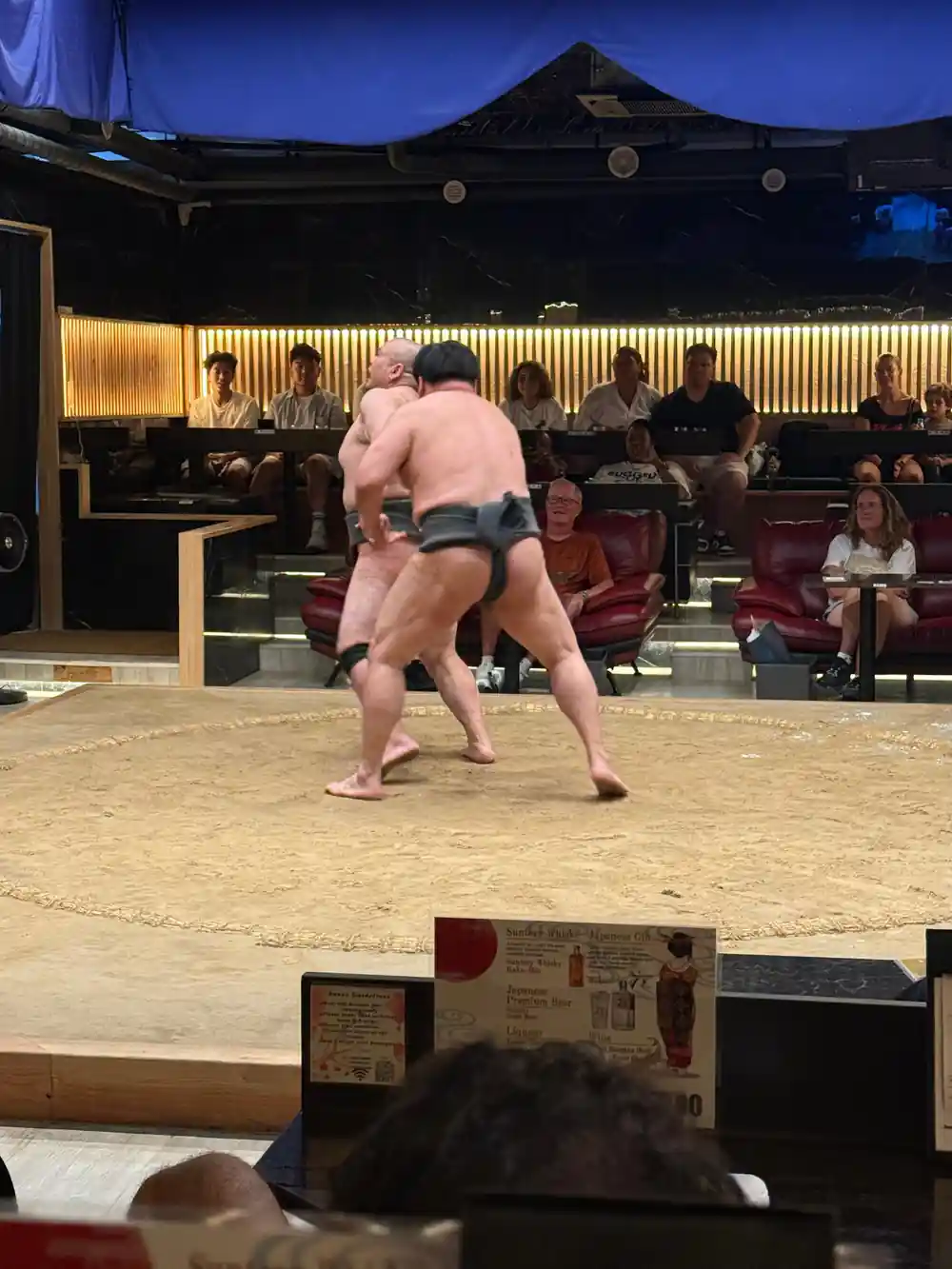
Between stomps the wrestlers crouch, meet eyes and withdraw, sometimes several times before they charge. The charge itself, the tachiai, is where a bout is often settled, and it happens fast: a contest usually lasts only a few seconds, though in rare cases it can take a minute or more.[2]
When the two collide, the win comes from one of the recognised techniques. There are 82 kimarite, or match winning techniques, and 5 non-techniques, or ways to lose, all defined by the Japan Sumo Association.[10] The referee names what he saw, the ring is swept, and the next pair steps up.
The Chonmage Topknot and Wrestler Identity
Wrestlers wear their hair long, oiled and gathered into a topknot, the chonmage, sitting forward on the crown in an old samurai style. It is a working hairstyle and a uniform at once, and it makes a sumo wrestler recognisable at a distance, whether he is on the clay or walking to the station in a yukata.
The sport sorts its wrestlers into six divisions covering ten ranks in total, and only the top division, Makuuchi, is subdivided further, into five separate ranks.[13] Watching a morning practice or a small show, you are seeing part of that pyramid: younger wrestlers drilling the same movements the top division uses.
At the very top is the yokozuna. As of November 2025, exactly 75 wrestlers have attained yokozuna status in sumo history.[9] Size is part of the picture: research from the Keio University Sports Medicine Research Center put the average weight of 25 makuuchi wrestlers at 161.2 kg (about 355 lbs), with an average height of 186.3 cm.[8] A rikishi's daily caloric intake ranges from approximately 5,000 to 8,000 kcal, and can sometimes exceed 10,000.[14]
From Shrine Ceremonies to National Sport and the Women's Dohyo Debate
Today the sport runs on a tournament calendar. Japan holds six Grand Sumo Tournaments each year, and the January tournament is the first of them.[15] Ryogoku in Tokyo is the traditional home of the ring, and when a tournament is on, the area around the arena fills with banners, chanko restaurants and souvenir shops.
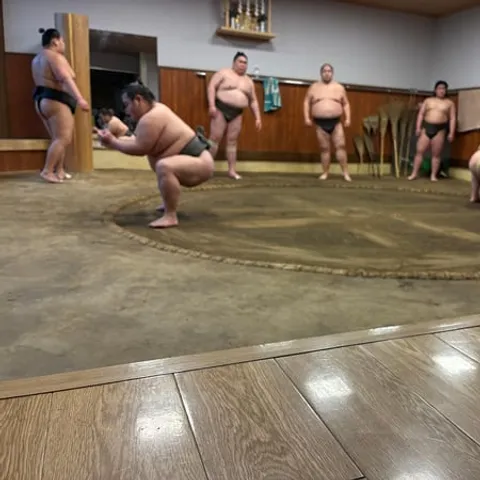
The working side of sumo happens much earlier in the day. Morning practice typically begins between 5:00 and 7:30 AM and continues for 2 to 4 hours, though the exact start time varies by stable and season.[3] That is what a stable visit is for: watching wrestlers train with no crowd, no music and no announcements.
The dohyo has also been a contested space. Women have historically been kept off the ring in professional settings, and the question of who may step onto the clay has been argued over in recent years. Evening shows have widened access for travellers: the Tokyo sumo entertainment show with chicken hot pot and geisha runs 2 hours and is wheelchair accessible.[4]
From prices for Tokyo sumo experiences
What a Tokyo sumo show costs
From prices in US dollars. Sources:[4],[19],[17],[18]. No separate child price is listed.
When sumo happens and when to book
Planning your sumo day
Choose your format
Decide between a working stable visit, a staged evening show and a tournament day. The three feel completely different, and only one of them fits a short trip.
Book with flexibility
Free cancellation up to 24 hours in advance applies to the tour booked from this site, so booking early does not lock you in.[4]
Learn the ring
Read up on the salt, the stomp and the crouch before you go, then watch the ring rather than your phone. The ritual is what makes the short bursts of wrestling readable.
Arrive with time
Give yourself margin for the walk from the station and for finding your seat, and keep your booking confirmation on your phone.
Watch practice properly
At a stable it is worth sitting still and staying quiet. Practice runs 2 to 4 hours and the wrestlers notice everything.[3]
See the dohyo, the salt and the stomp up close in Tokyo
from US$102Reserve now & pay later