The essentials
- Listed from US$102 per person, with free cancellation up to 24 hours in advance for a full refund and the option to reserve now and pay later.[1]
- The show runs 2 hours. Starting times are shown when you check availability, so pick the slot that fits your evening in Asakusa.[1]
- A bout usually lasts only a few seconds, though in rare cases it can take a minute or more. The ritual around each bout is a big part of the night.[2]
- Chicken hot pot is part of the listing, and chanko nabe is sumo's famous dish. A rikishi's daily caloric intake runs from approximately 5,000 to 8,000 kcal.[1][3]
- Small group availability and wheelchair accessibility are part of the listing, which suits families and mixed-age groups.[1]
- Top choice Sumo show, hot pot, geisha from US$102 Duration2 hours[1]Rating4.79 from 8,004 reviews[1]FormatRing show with a mealPay laterReserve now & pay later[1]CancellationUp to 24 hours[1] Check availability
- Dining show at a sumo house from US$89 Duration1.5 - 2 hours[4]Rating4.80 from 3,454 reviews[4]FormatShow and dining in one venuePay laterReserve now & pay later[4]CancellationUp to 24 hours[4] See this tour
- Morning practice viewing from US$102 Duration1.5 - 2 hours[5]Rating4.78 from 720 reviews[5]FormatStable practice viewingPay laterReserve now & pay later[5]CancellationUp to 24 hours[5] See this tour
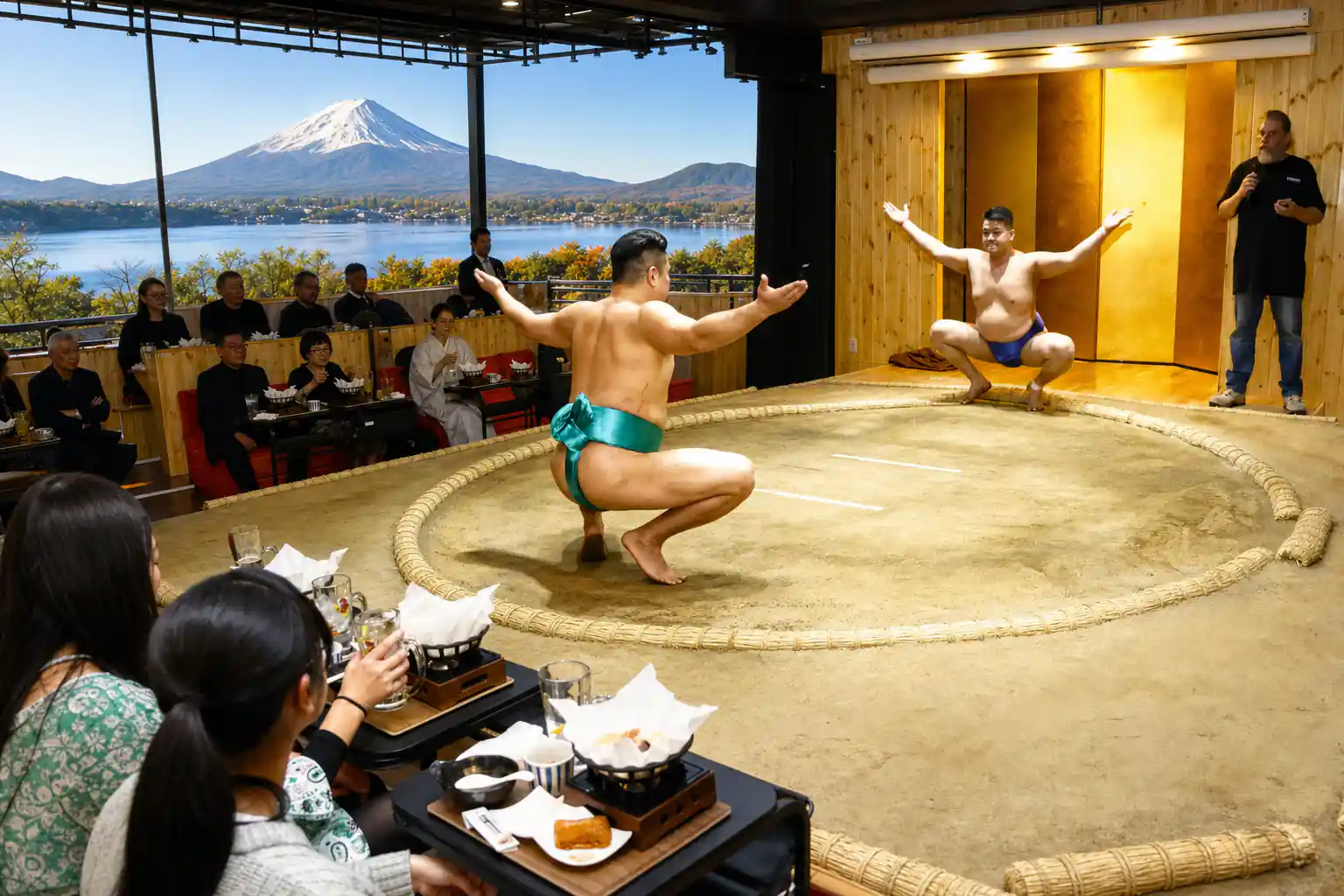
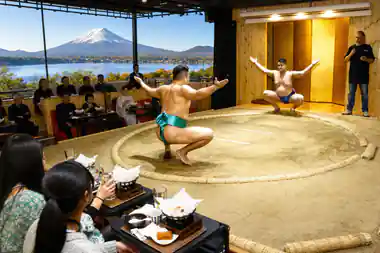
He then performs chiri-chozu : squatting low, extending both arms to the sides with palms turned upward, demonstrating to the gods and his opponent alike that his hands hold no weapons. He throws salt.
Is the Asakusa Sumo Club show worth it?
Booking notes
On the night
- Wheelchair accessible, with small group availability[1]
- Keep your booking on your phone and arrive with time to settle in
- Layers help, since a room with a hot pot and a crowd warms up
- Talk to your table, because the hot pot is a shared dish
Asakusa, sumo, and a ring in the middle of the room
Asakusa still looks like the Tokyo of postcards: paper lanterns strung over the shopping streets, temple roofs rising above the crowd, rickshaws weaving between snack stalls, and shopfronts selling everything from knives to melon bread. Tucked into these blocks is the Asakusa Sumo Club, an indoor venue with pink signage out front, a blue annex next door and a ring of sand in the middle of the main arena. You step in off a busy shopping district, show your booking on a phone, and sit close to where the wrestlers work.
That closeness is the whole point of the Asakusa Sumo Club Tokyo show. Nobody needs binoculars or a commentary headset. It is a room, a ring and a programme built for people who have never watched sumo before and want to understand what is happening in front of them. The evening mixes wrestling with a meal and a bit of theatre, which makes it an easy first night in the city, especially if you have just landed and are still finding your feet.
The booking is straightforward. The Tokyo Sumo Entertainment Show with Chicken Hot Pot and Geisha is listed from US$102, runs 2 hours, and shows its starting times when you check availability.[1] Small group availability and wheelchair access are part of the listing as well.[1] You choose a slot, keep the confirmation, and turn up.
What happens inside the ring
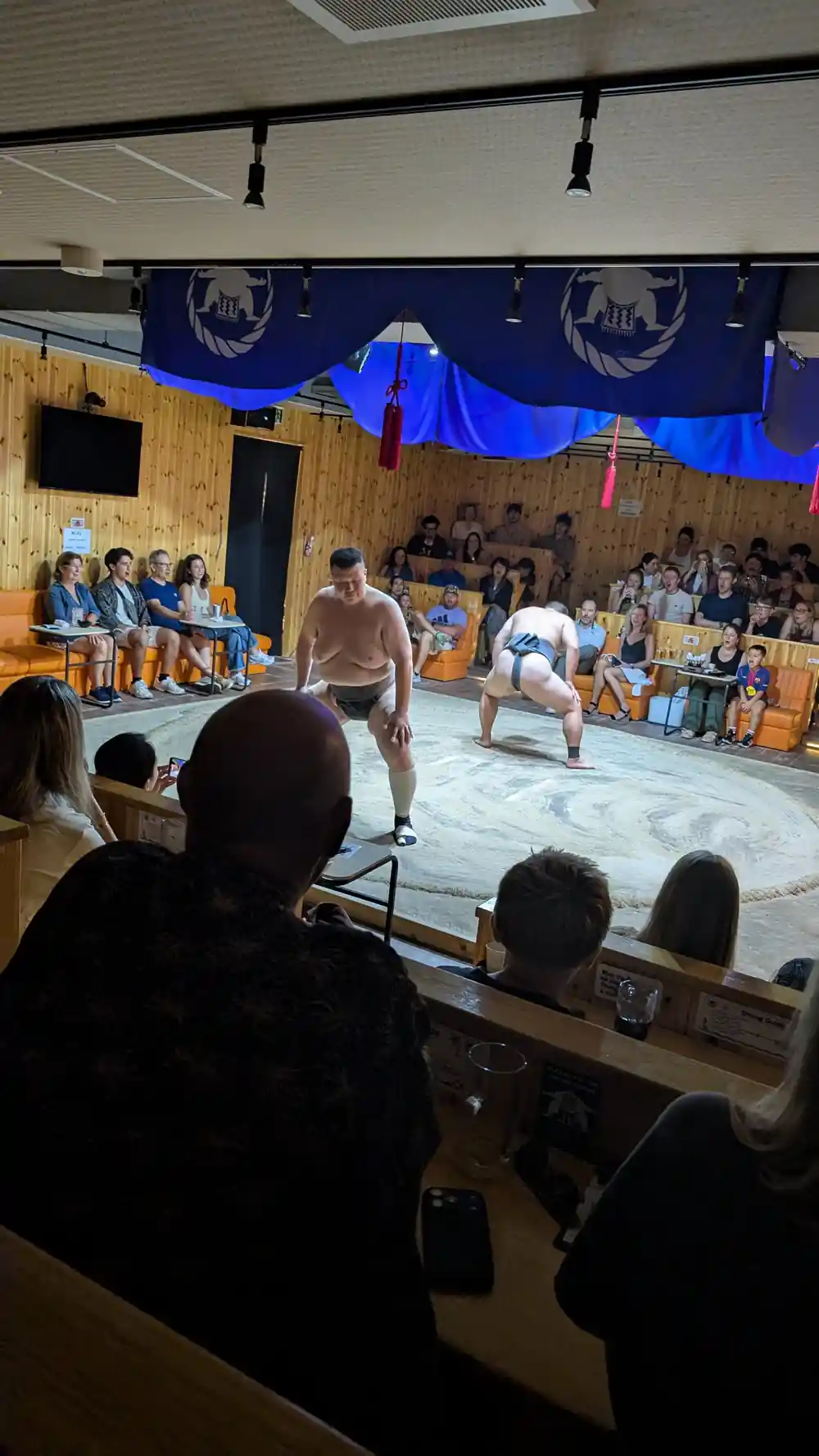
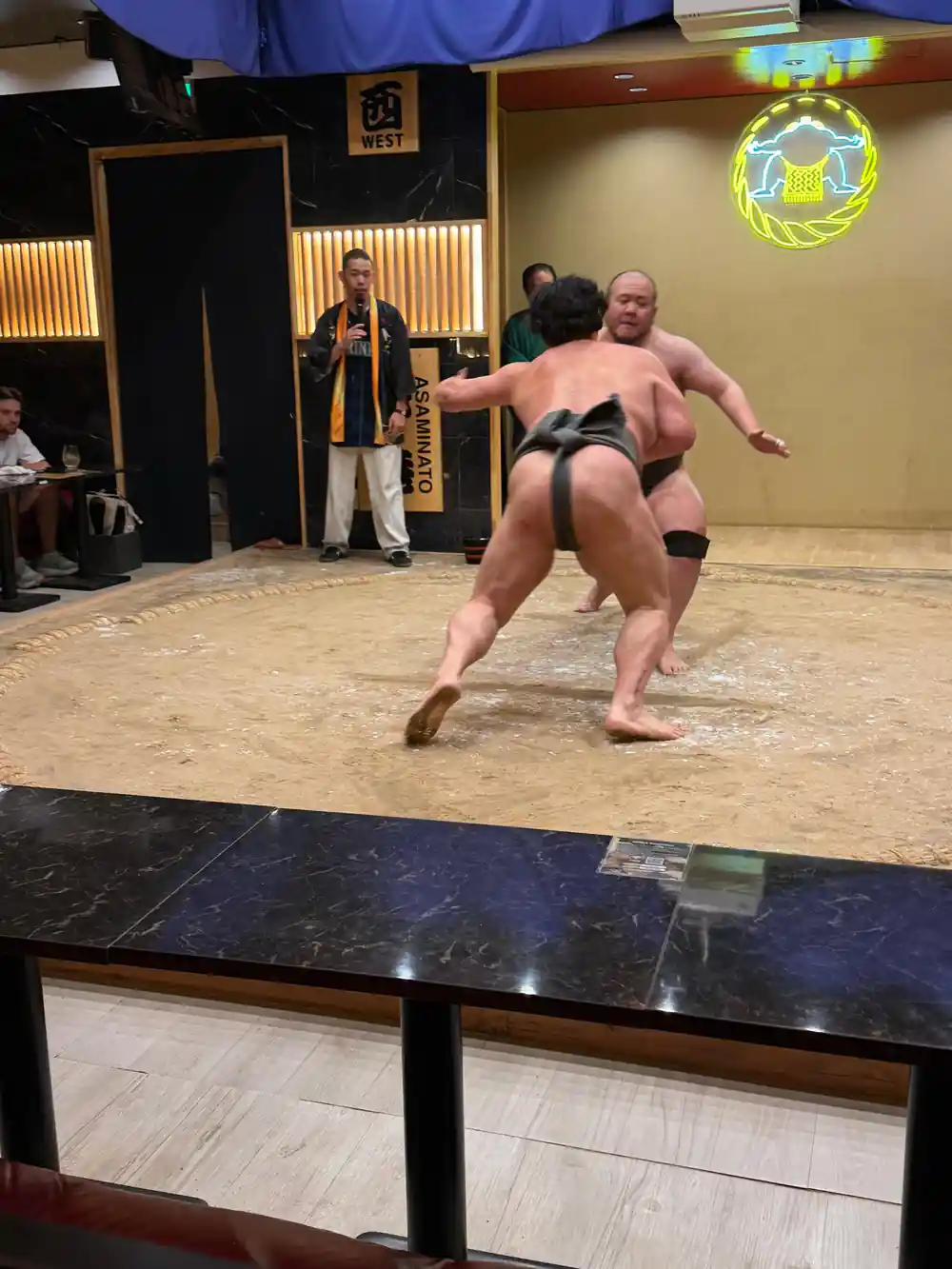
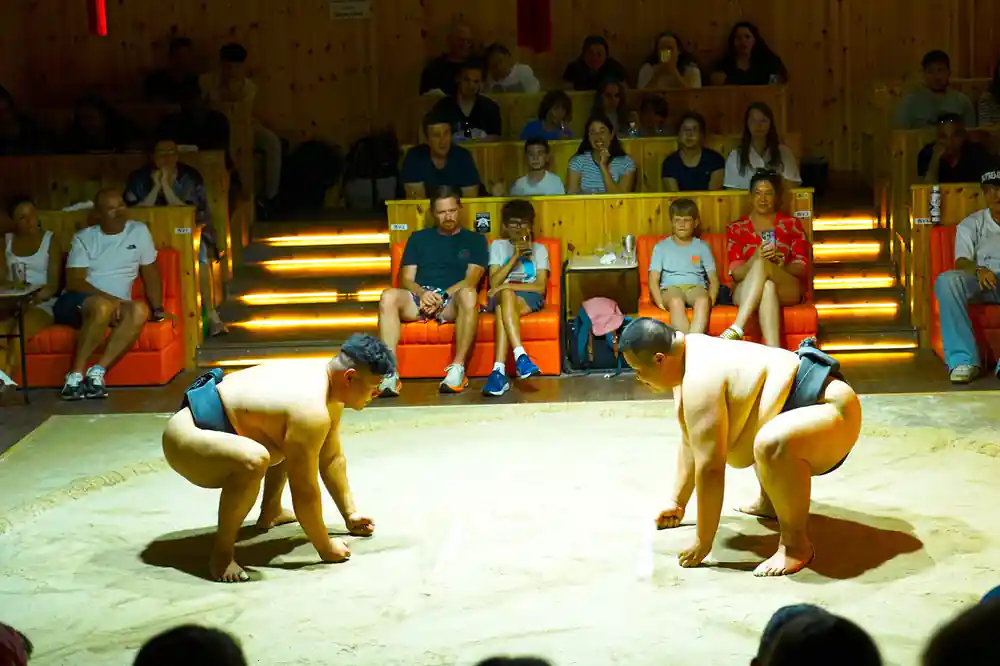
A sumo bout is a strange, gripping thing the first time you see one up close. Two very large men face each other, crouch, touch the sand, and then it is over, or so it seems. A contest usually lasts only a few seconds, though in rare cases it can take a minute or more.[2] The slow part is everything around it: the announcing, the crouch, the pause, the charge, and the sudden noise from people who were not sure what to expect.
Before a bout the wrestler performs chiri-chozu, squatting low with both arms extended to the sides and palms turned upward, showing the gods and his opponent that his hands hold no weapons, and then he throws salt.[6] Sitting close means you can see the hands, the faces and the sand spray, and you notice how much of the sport is timing rather than brute force. That is the argument for a small venue over a distant seat.
If you want to sound informed on the night, there are 82 kimarite, or match winning techniques, and 5 non-techniques or ways to lose, all defined by the Japan Sumo Association.[7] Sumo also sorts its wrestlers into six divisions covering ten ranks in total, and only the top division, Makuuchi, is subdivided further, into five separate ranks.[8] Good commentary touches on this without turning the evening into a lecture, and you will pick up the vocabulary quickly enough.
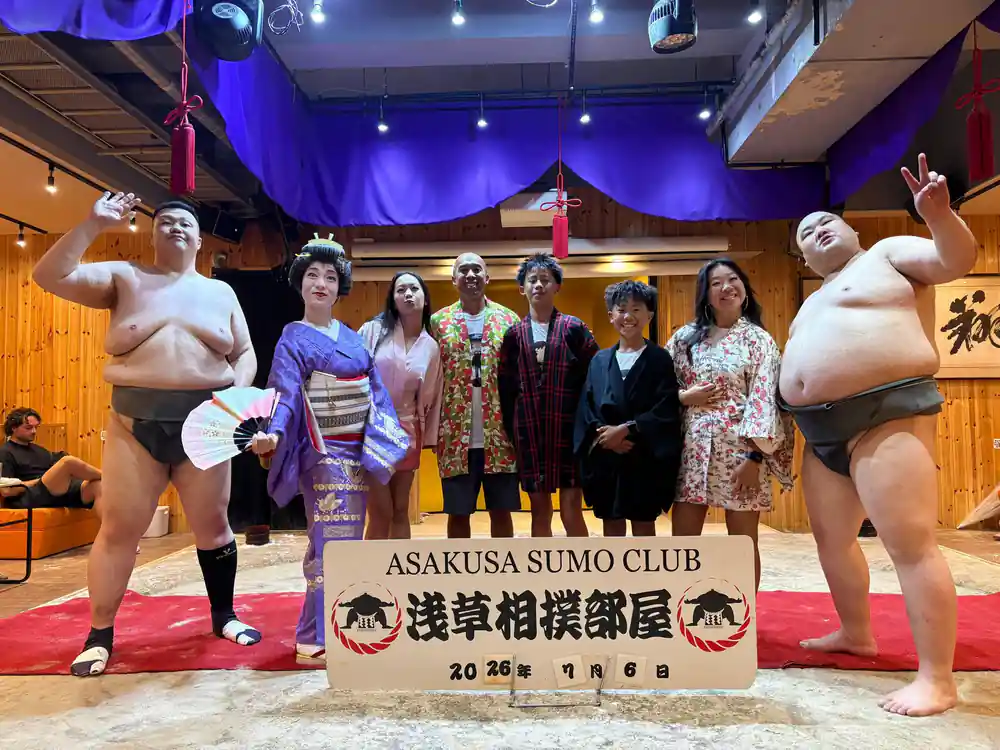
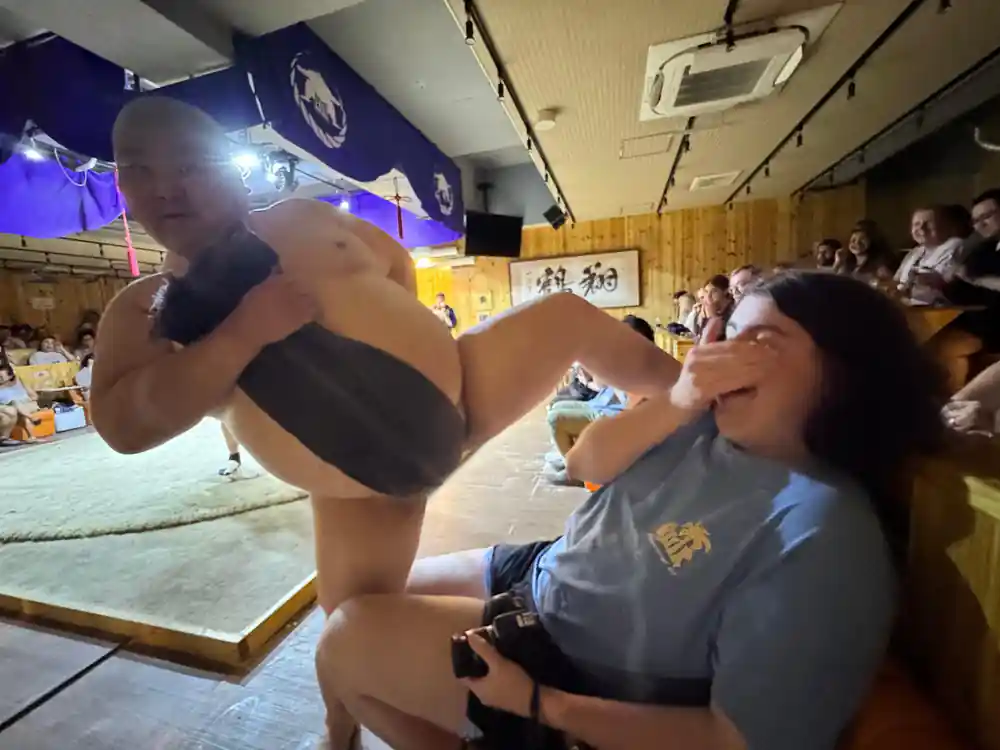
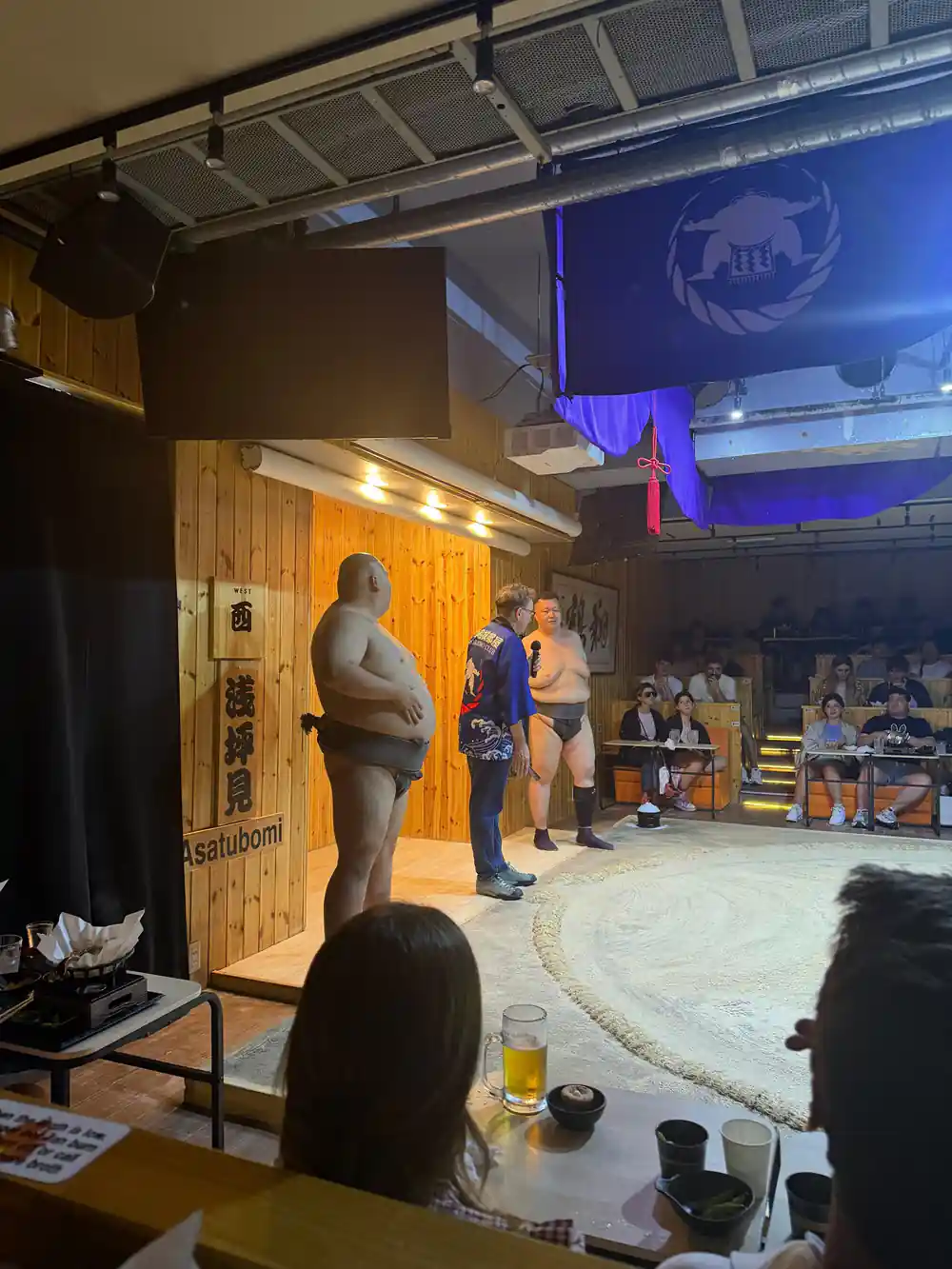
Wrestlers take the ring at a Tokyo sumo show while the audience watches from close up.
Chicken hot pot, chanko nabe and what wrestlers eat
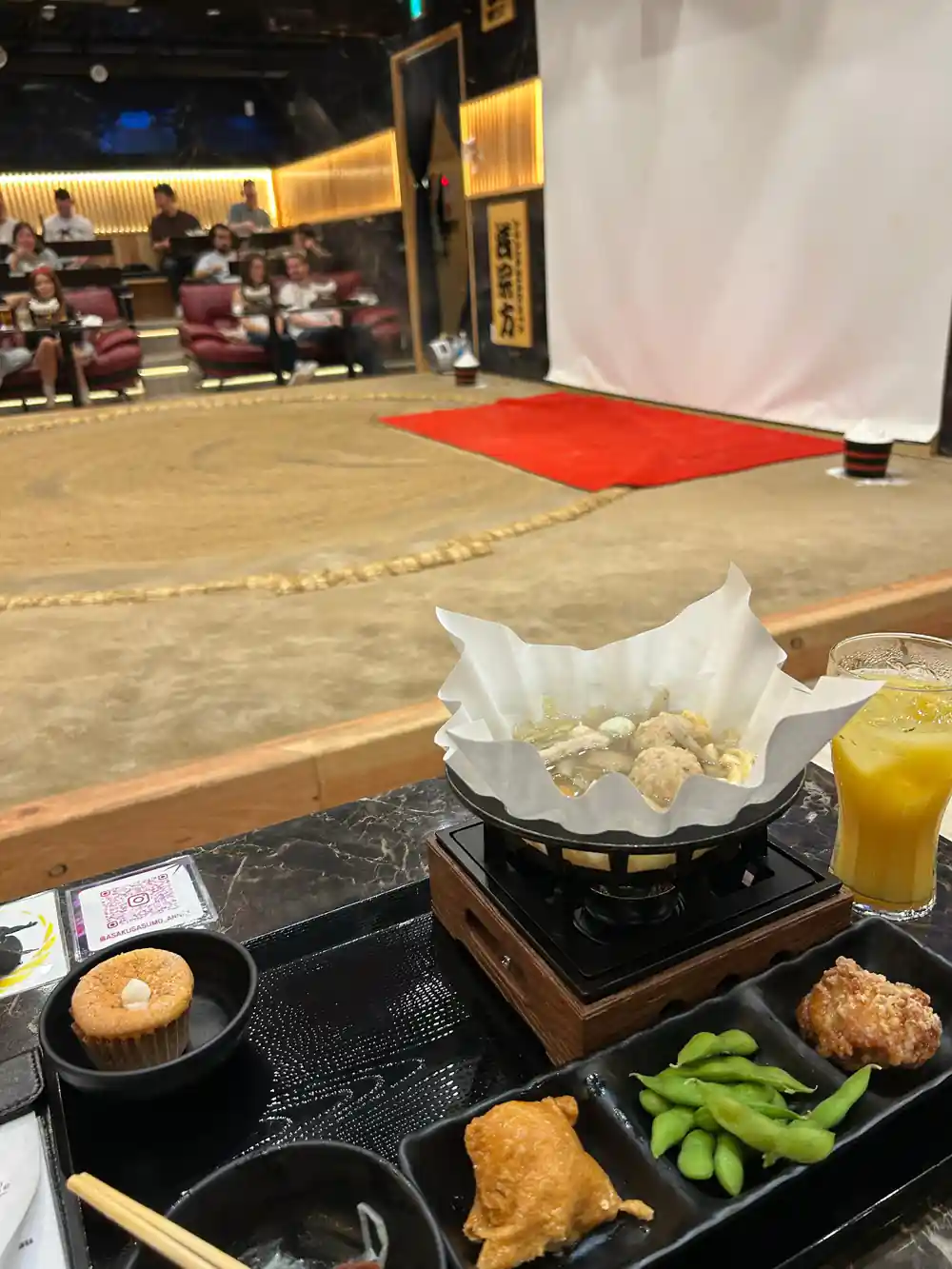
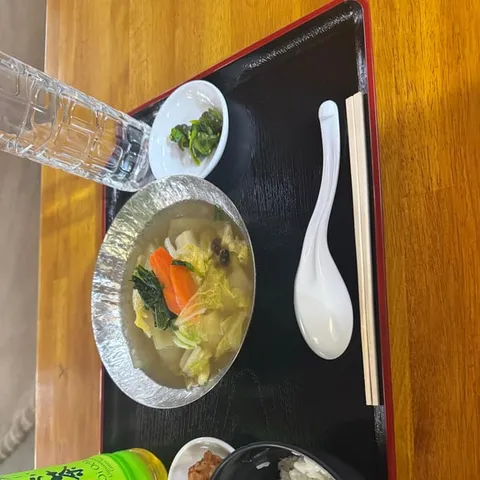
Chanko nabe is the dish most people picture when they think of sumo: a shared pot cooked at the table, filled with broth, chicken and vegetables, eaten in enormous quantities by people who have trained all morning. The Asakusa Sumo Club Tokyo chanko nabe show is built around a chicken hot pot, so dinner and the spectacle arrive together rather than as two separate errands. It is a sociable way to eat, and the pot sits in the middle of the table where everyone can reach it.
The numbers behind that diet are startling. A rikishi's daily caloric intake ranges from approximately 5,000 to 8,000 kcal, and can sometimes exceed 10,000.[3] According to research by the Keio University Sports Medicine Research Center, the average weight of 25 makuuchi wrestlers was 161.2 kg (about 355 lbs), with an average height of 186.3 cm.[9] The pot on your table makes more sense once you know where those calories go, and why the training and the eating belong to the same job.
Practically, eat early if you want to be comfortable later in the evening. The broth keeps improving as it reduces, the table gets louder as it empties, and sharing a pot with strangers is half the fun of a chanko meal. Pace yourself on the broth if you plan to walk home afterwards.
The geisha part of the evening
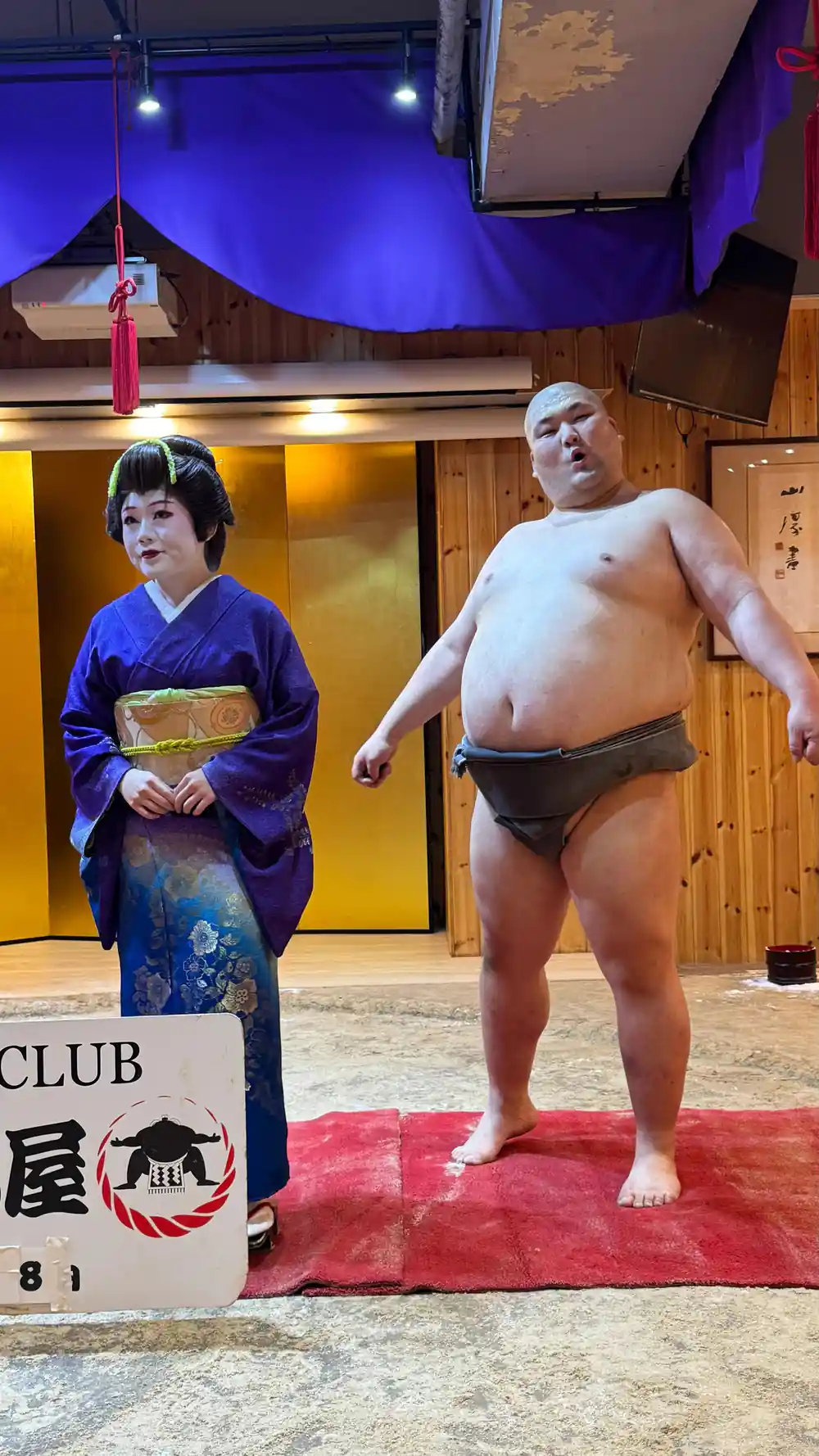
The other half of the billing is the geisha, and for plenty of visitors that is the surprise of the night. A performer in kimono works the room, and the pictures from the venue include a woman in pink kimono performing with a glowing ball. The staging is lively rather than formal, closer to a variety show than a quiet tea house, and the audience is encouraged to react rather than sit in silence.
If you have never watched this kind of performance from a few feet away, a few things are worth noticing. Watch the hands, the angle of the head and the way the long sleeves are managed, because those small movements are trained and precise. In a small room you can actually see them, which is rarely true from the back of a theatre, and the tiny hesitations are as expressive as the big gestures.
Photographs are part of the fun at this sort of show, and guests usually leave with a picture or two. Ask before pointing a lens at anyone, including other guests, and keep the flash off during a performance so nobody is blinded mid-turn. A phone on silent is the easiest courtesy you can offer a performer who is working without a stage barrier.
from US$102
The Tokyo Sumo Entertainment Show with Chicken Hot Pot & Geisha is listed from US$102 and rated 4.79 from 8,004 reviews.[1]
Who the show suits, and who should book practice instead
For families, mixed-age groups and anyone who wants a seat, a meal and a fixed finish time, the listing includes small group availability and wheelchair accessibility.[1] If somebody in your party is unsure about sumo, the show is a low-risk introduction: warm, short and finished early enough for a nightcap or a train back to the hotel.
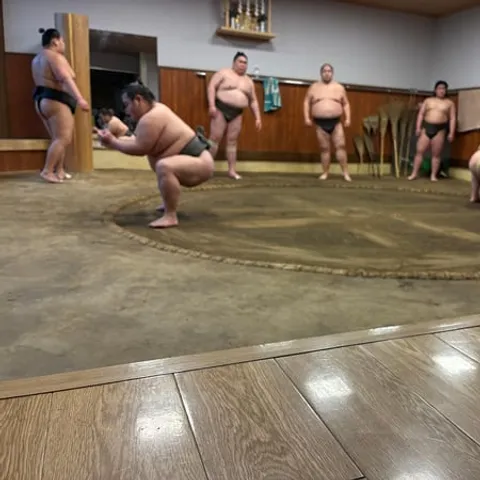
The opposite experience is a morning visit to a stable, where you sit quietly and watch wrestlers train. Morning sumo practice typically begins between 5:00 and 7:30 AM and lasts 2 to 4 hours, though the exact start time varies by stable and season.[10] That is a working session, not a performance, and the mood is serious. Fewer people speak, phones are put away, and what you see is repetition rather than spectacle.
Do both if your schedule allows. A morning at a stable shows you what the sport actually is, and an evening show shows you why people fall for it. Children often last longer at the show, where there is food and noise, while early risers and photographers tend to prefer the practice, where the light is quiet and the wrestlers are absorbed in their own work.
Prices, ratings and the rest of the Tokyo listings
The Tokyo Sumo Entertainment Show with Chicken Hot Pot and Geisha is listed from US$102 and rated 4.79 from 8,004 reviews.[1] Cheaper Tokyo options exist if the budget is tight: a Shinjuku sumo show and experience with photo is listed from US$65[11], and a Ginza show with a live performance is listed from US$61.[12] A sumo show and dining experience at a historic sumo house is listed from US$89[4], and a sumo morning practice viewing tour is listed from US$102.[5] The real question is which format suits your evening.
If your dates line up with a tournament, the big arena is a different pleasure. Japan holds six Grand Sumo Tournaments each year, with the January tournament being the first of them.[13] The Kokugikan National Sumo Arena in Ryogoku, Sumida City, Tokyo, has a capacity of up to 10,000.[14] Second-floor B or C arena seats cost between 3,500 and 5,500 yen.[15] As of November 2025, exactly 75 wrestlers have attained yokozuna status in sumo history.[16]
For the show, the terms are relaxed. Reserve now and pay later is offered, and free cancellation applies when you cancel up to 24 hours in advance for a full refund.[1] If your flights move or your plans shift, that flexibility is worth more than chasing a slightly cheaper ticket, particularly on a short trip where every evening is precious.
Building a day around the Asakusa show
Asakusa rewards slow walking. Start at the temple end of the shopping street, drift into the side lanes for knives, brushes and snacks, then loop back towards the river before your show slot. The district is compact and mostly flat, so an afternoon on foot costs you very little energy, and there are tea shops and standing bars whenever you need to sit down.
For the show itself, wear layers and carry your booking on your phone. A room with a crowd, a hot pot and a ring warms up quickly, and you will be sitting for the length of the show, which the listing gives as 2 hours.[1] Comfortable shoes help more than a smart outfit, since you will almost certainly keep walking afterwards.
A stable visit in the morning and the show in the evening can share the same day; morning practice typically begins between 5:00 and 7:30 AM.[10] Book the show first, then build the rest of the day around it, and check availability for the exact date you want before locking in anything else. If you are travelling as a group, agree on one date early so everyone can plan around the same evening.
GetYourGuide ratings for Tokyo sumo experiences
From-prices per person in US dollars
From-prices per person from GetYourGuide listings:[1][4][5][11]
When to go and when to book
How to plan your visit
Pick your date
Look at the starting times for the evening you want, since they are shown when you check availability.[1]
Book the show
The listing offers reserve now and pay later, so you can lock in a slot before you pay.[1]
Plan the district
Asakusa is compact and walkable, so pair the show with an afternoon around the temple streets.
Add a morning
For real training, morning practice typically begins between 5:00 and 7:30 AM and lasts 2 to 4 hours.[10]
Stay flexible
Free cancellation applies when you cancel up to 24 hours in advance for a full refund.[1]
Book the Asakusa Sumo Club show with hot pot and geisha
from US$102Reserve now & pay later